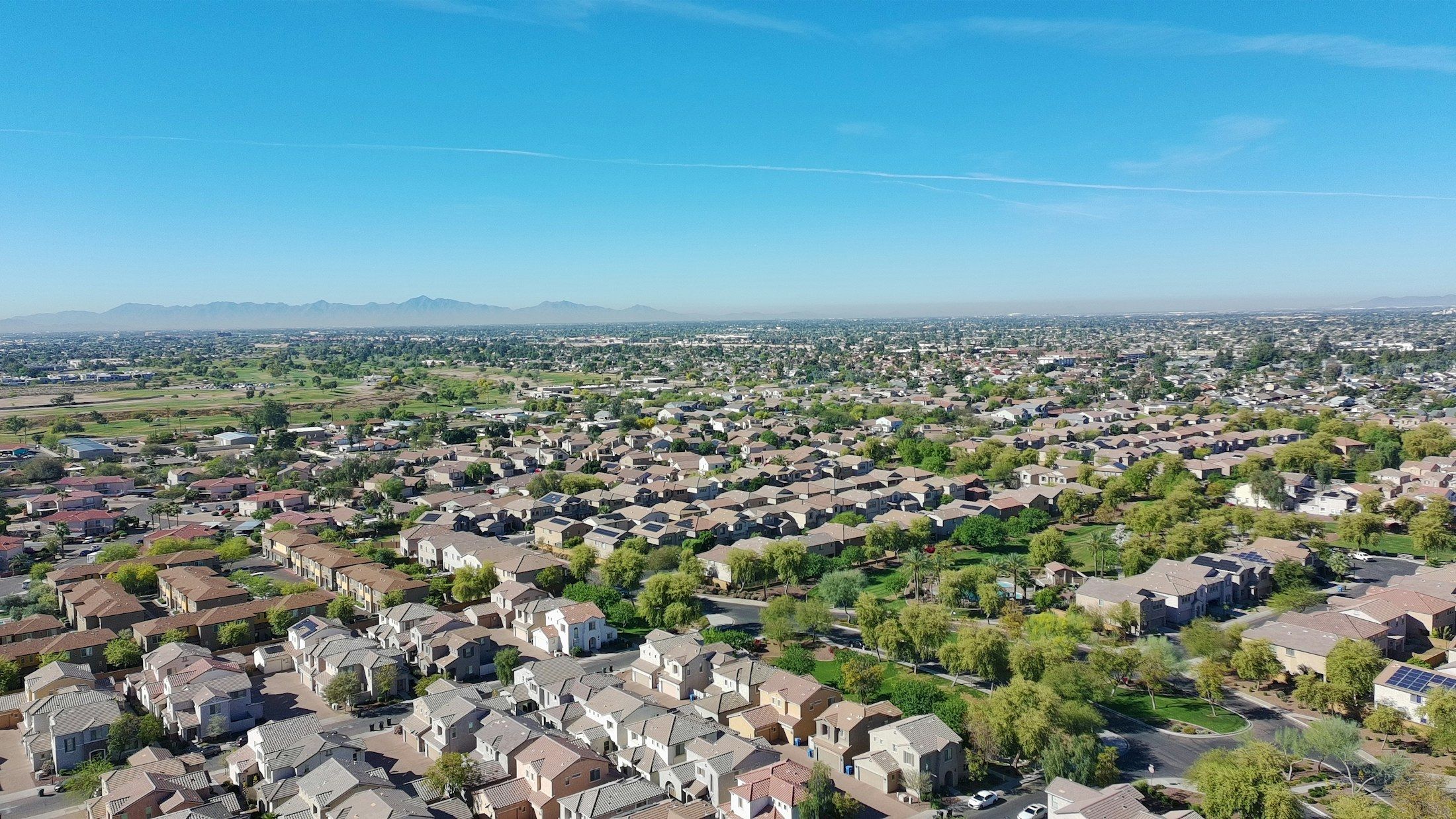
What people mean by North Phoenix
North Phoenix isn’t an official city name. Phoenix is divided into 15 urban villages, which are planning areas with advisory committees, and none of them is called North Phoenix. The term is commonly used for five of them, though people draw the edges differently:
- Paradise Valley Village: from the Phoenix Mountains to the Central Arizona Project (CAP) canal, between 16th Street and Scottsdale. Not to be confused with the Town of Paradise Valley.
- North Mountain: between Northern Avenue and Greenway Road, including neighborhoods in the foothills of the Phoenix Mountains.
- Deer Valley: from the Greenway corridor north to the CAP canal and Jomax Road, west of 16th Street.
- Desert View: natural washes, horse properties and master-planned communities.
- North Gateway: the city’s northern entrance, with master-planned communities and scenic washes.
Older homes near the mountains, newer ones up north
Census figures (American Community Survey, 2020–2024) by ZIP code show the spread. Near the Phoenix Mountains, the median home was built in 1975 in 85029 and 1976 in 85028, and more than 60% of homes in each went up between 1960 and 1979. Farther north, the median jumps to 2009 in 85085 and 2010 in 85054.
What to watch at each end:
- 1970s homes. The University of Arizona says slab foundations are the most common type in Arizona, and a leak in a line under the slab can soak flooring without a visible puddle. Warm spots on the floor after running hot water are one sign. See slab leak water damage.
- Homes built since 2000. Many are now old enough that an original water heater is past its typical life. Supply lines, appliances and AC drains fail in new houses too. See water heater and appliance leaks.
Deer Valley
The city’s 2016 character plan calls Deer Valley an active area for building single-family homes, and its housing runs from the 1970s to the 2000s. Three things set it apart.
Adobe Dam and Skunk Creek. The U.S. Army Corps of Engineers built Adobe Dam to control flooding along Skunk Creek. According to Arizona State University, it controls flood water from an 89.6-square-mile drainage area north of the Hedgpeth Hills. It manages creek flows, not a roof leak or runoff across your lot.
More rain than Sky Harbor. Phoenix-Deer Valley Airport averages 8.90 inches of rain a year (1991–2020), about 1.7 inches more than Sky Harbor’s 7.22.
Manufactured homes. In ZIP code 85027, which lies entirely within the village, 8.8% of homes are mobile or manufactured. In a manufactured home, much of the plumbing runs under the floor, out of sight. A soft spot in the floor, a musty smell or a meter that keeps moving with everything off can point to a leak underneath. Drying a wet subfloor takes more than fans; see structural drying.
Paradise Valley Village
Paradise Valley Village is the Phoenix planning area. The Town of Paradise Valley is a separate municipality next door, and the two don’t overlap. If you live in the Town, see our Paradise Valley page.
The village’s homes lean older. In ZIP code 85028, almost entirely inside the village, the median home was built in 1976, about 42% of homes date from the 1970s and about 83% are owner-occupied. In 85032, which lies fully inside the village, the median is 1984 and about 6% of homes are mobile homes.
The village plan credits its open-space character to the surrounding mountains, its trails and the Indian Bend Wash greenbelt, which “was designed as a flood control greenbelt.” When the wash is running, follow the Flood Control District’s advice and stay out of flooded areas. Six inches of water can knock you off your feet.
Storm runoff across the north
The Desert View village plan notes natural washes that generally flow from the northeast to the southwest. During the September 16, 2026 storm, National Weather Service photos showed a truck stranded in floodwaters from Sonoran Wash along North Valley Parkway and a vehicle stranded in Skunk Creek floodwaters along Dove Valley Road, both in North Phoenix.
Before storms, clear roof drains, scuppers and drywells, as the City of Phoenix advises. FEMA notes that most homeowners insurance doesn’t cover flood damage. More on monsoon and storm water damage.
If water is coming in now
- Stop the water at the fixture or the main shut-off valve.
- Stay out of water near outlets, cords or the electrical panel.
- Photograph the damage before you move anything.
- Call to reach an independent restoration provider that serves your part of North Phoenix. If it’s a manufactured home, say so.
The first-hour guide covers each step.