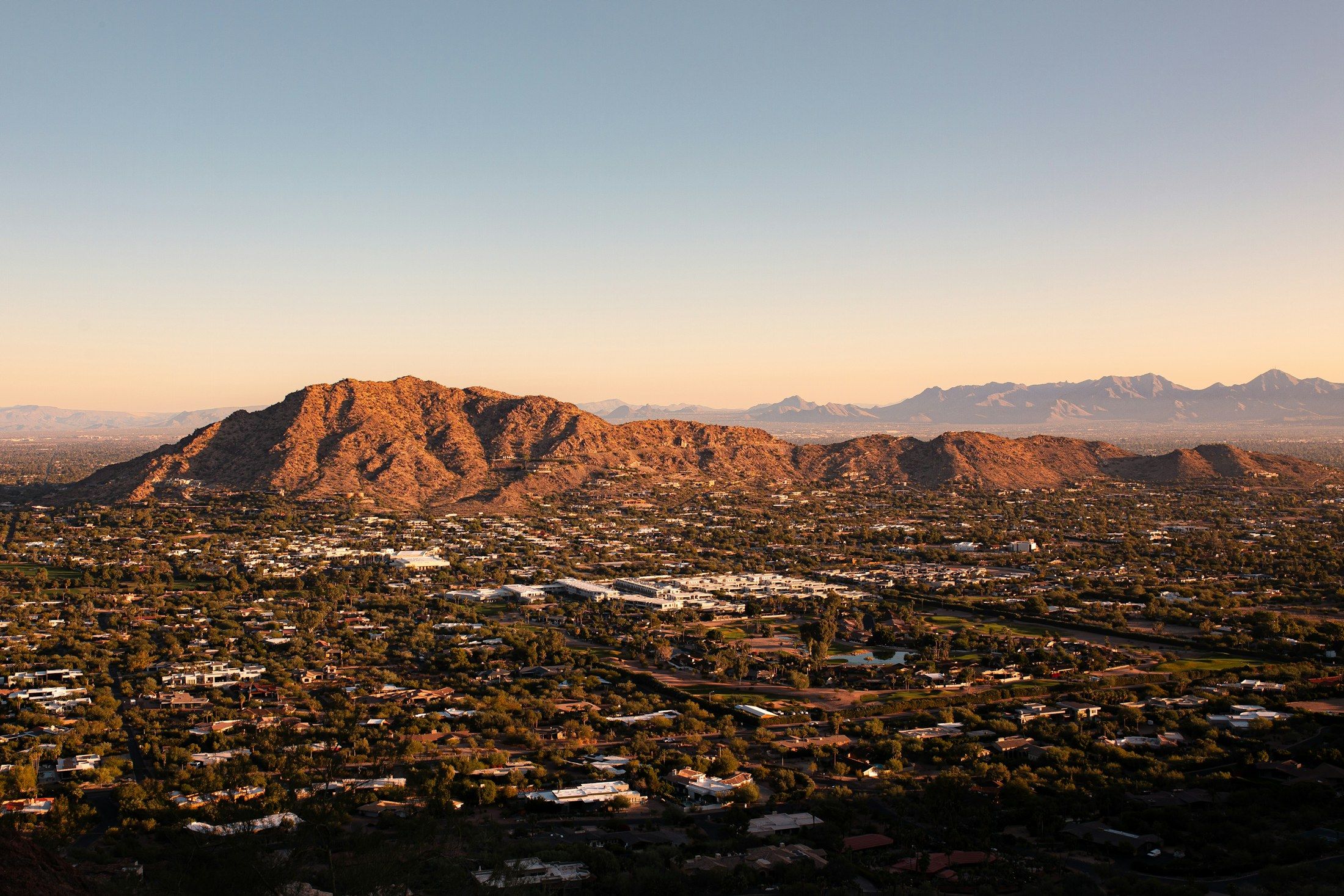
Arcadia and Camelback East
Arcadia isn’t one of Phoenix’s 15 urban villages. It’s a neighborhood in the northeast part of the Camelback East village, so if you searched for Camelback East, this page applies to you too. The city’s 1999 Arcadia Camelback Special Planning District runs from 44th Street to 64th Street, between the Stanford Drive alignment and Indian School Road.
People often use the name more broadly. The same plan describes traditional Arcadia as the area between Camelback Mountain and the Arizona Canal, from 44th Street to Scottsdale Road. The part east of 64th Street is in Scottsdale. If that’s you, see our Scottsdale page.
Much of what follows holds across Camelback East. The city says a major portion of the village’s housing was built between 1950 and 1970, and the village plan describes established neighborhoods “with flood irrigated lots located in areas which once were occupied by citrus groves.”
From citrus lots to ranch homes
Arcadia was platted in December 1919 as lots of about 5 and 10 acres, laid out to be sold as small citrus orchards. The Arcadia Water Company formed the same year, and by 1924 crews had laid fifteen miles of underground concrete pipe. Phoenix growth reached the area in the mid-1950s. In 1990, homes built in the 1950s made up 41% of the area’s housing.
Census figures (American Community Survey, 2020–2024) for ZIP code 85018, which includes Arcadia and nearby parts of Camelback East, put the median home at 1970. The 1950s are the largest single decade there, and 64.5% of homes were built before 1980.
Two things follow from that age:
- Plumbing with decades on it. Supply lines, valves and drain pipes that have been in place for 50 years or more are worth having checked before they fail. A leak inside a wall or ceiling is covered on our burst pipe water damage page.
- Lead paint and asbestos. Both are possible in houses this age, and both matter when wet drywall or flooring has to come out. The FAQ below has the EPA’s guidance.
Flood-irrigated lots
Irrigation has been part of Arcadia since the citrus days. If your lot still takes irrigation water, the yard fills a few inches deep on delivery day. SRP, which delivers flood irrigation to about 20,000 properties around Phoenix, gives advice that fits any flood-irrigated yard:
- Keep berms twice the height of the water you receive.
- Don’t order more water than you need. SRP warns that too much can cause flooding and property damage.
- In SRP neighborhoods, the pipes and valves past the delivery gate are private and maintained by residents.
If irrigation water gets inside, move rugs and furniture out of it and start removing it quickly. The EPA advises drying water-damaged materials within 24 to 48 hours to prevent mold growth. For standing water indoors, see emergency water extraction. A musty smell weeks later can mean moisture was missed, and our guide to signs of hidden mold covers where to look.
Runoff from Camelback Mountain
Storm water in Arcadia flows south from Camelback Mountain toward the Arizona Canal. The city’s 1999 Arcadia Camelback plan says that runoff has been “occasionally flooding streets, and in years past, homes in the area.” Before remedial measures taken since 1972, ponding on the north bank of the canal put some areas in a 100-year floodplain. The Flood Control District of Maricopa County studied Arcadia drainage in 1994 and 1995, and the plan recommended building drainage facilities to improve it.
In a monsoon storm, water moving downhill across a lot can reach doors and low entrances. The Flood Control District’s sandbag advice: fill bags half to two-thirds full, stack them in a brick pattern, and focus on front doors and low entrances. For roof leaks and storm water that got inside, see monsoon and storm water damage.
Before the drying starts
- Stop the water at the fixture or the main valve, which may be at the front or the back of an older house.
- Keep children and pets away from water that came in from outside. The CDC notes that floodwater may contain sewage.
- Photograph the water and the damage before you move anything.
- If your home was built before 1978, ask how lead paint will be handled before any drywall is cut.
- Call to reach an independent restoration provider that serves Arcadia.