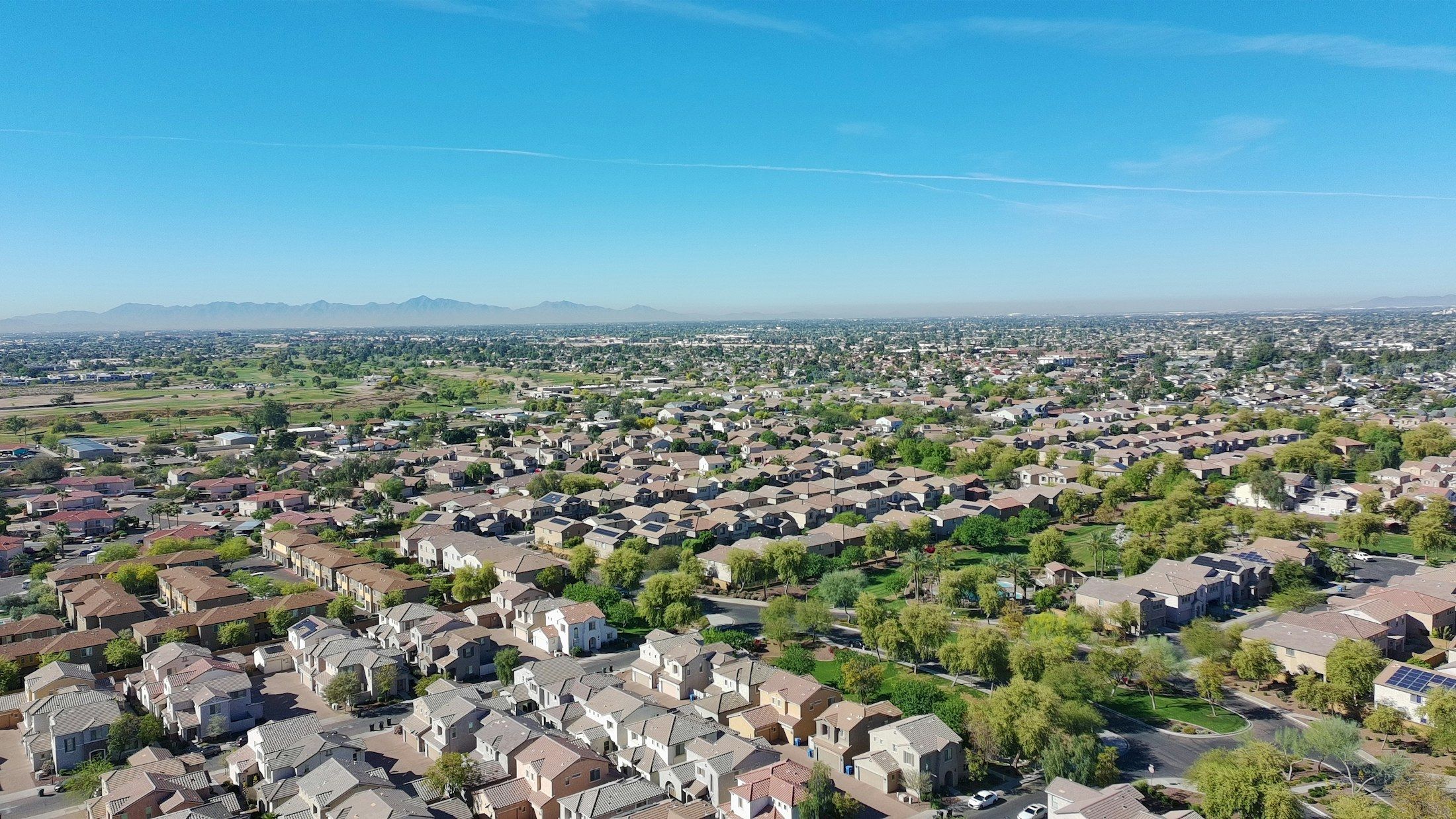
A city built mostly in the 1990s
U.S. Census Bureau survey data (American Community Survey, 2020–2024) puts the median Chandler home at 1997. The 1990s were the busiest decade for construction, and about 73% of homes went up between 1980 and 2009. Fewer than 10% predate 1980.
North and south Chandler differ. The city describes downtown and several neighborhoods in ZIP codes 85224 and 85225 as long-established, and the median homes there date to 1989 and 1991. In south Chandler, ZIP codes 85249 and 85286 have medians of 2005 and 2006. About 6% of homes in 85225 are mobile homes.
A typical Chandler house is now about 30 years old. ENERGY STAR puts the life of a tank water heater around 13 years, so most of these homes have likely replaced at least one. Supply lines, washing machine valves and the small shut-off valves under sinks may still be the originals. See water heater and appliance leaks.
September 8, 2014
On September 8, 2014, the remnants of Hurricane Norbert dropped 3.30 inches at Sky Harbor, the most for any calendar day in Phoenix since records began in 1895. Chandler got more. The National Weather Service reported that some Chandler locations recorded nearly 6 inches, and a trained spotter measured 6.09 inches in northwest Chandler. NWS photos from that day show flooding at Dobson and Loop 202, McClintock and Ray, Ocotillo and McQueen, and Warner and Arizona Avenue.
A storm like that is rare, but it shows how quickly streets and yards can fill when rain outpaces drainage.
Where water ponds in Chandler
The City of Chandler says several small areas of the city lie in the 100-year floodplain. They’re generally next to canal banks and railroad track embankments, where water ponds in heavy rain. West Chandler is also part of the Tempe Area Drainage Master Study. The city says it can help evaluate and reduce ponding and flooding problems, so if water collects against your house after every storm, ask the city’s floodplain staff.
The city is direct about insurance too: most homeowners policies don’t cover flood losses. Flood coverage is a separate policy, and FEMA says it usually takes 30 days to go into effect. For roof leaks and water that came in during a storm, see monsoon and storm water damage.
Your basin, your drywell
Chandler’s Property Owner’s Manual for Stormwater Management says private property owners, including HOAs, must maintain the storm water features on their property: retention basins, drywells and underground retention. The manual flags two things to watch:
- Standing water. Water that stays in a basin for more than 36 hours is a warning sign.
- Clogged drywells. Drywells are “highly susceptible” to losing effectiveness from clogging.
A basin that is still half full when the next storm arrives has less room to hold water. If a basin on your lot or your HOA’s land stays wet for days, get it looked at before monsoon season.
Chandler’s water and your water heater
Chandler’s 2025 water quality report puts total hardness at 10.1 to 16.8 grains per gallon. Hard water leaves scale in pipes, fixtures and water heaters. If you use a water softener, keep in mind that a report prepared for the U.S. Department of Energy notes softened water can wear out a tank’s anode rod faster, so have the anode checked more often.
Using the meter to find a leak
The City of Chandler describes a meter check any homeowner can do:
- Find the meter box. It’s generally near the sidewalk in front of the home, in a direct line with the main outside faucet.
- Turn off everything that uses water. The city notes that an evaporative cooler, an automatic pool filler or a leaky irrigation valve can keep the meter moving.
- Watch the meter. If it still moves, close your home’s valve, which is usually under the outside faucet near the front of the house.
- If the meter keeps moving, the leak is in the line between the meter and your valve.
If the meter stops once your valve is closed, the leak is somewhere in the house. Warm spots on the floor or damp flooring with no visible source can point to a line under the slab. See slab leak water damage.
When you find water
Close the house valve, stay clear of wet outlets and cords, and take photos before you move anything. Then call to reach an independent restoration provider that serves Chandler, plus a plumber if a pipe or fixture needs repair. The EPA advises drying water-damaged areas within 24 to 48 hours to prevent mold, so don’t wait on a wet wall. The first-hour guide walks through each step.