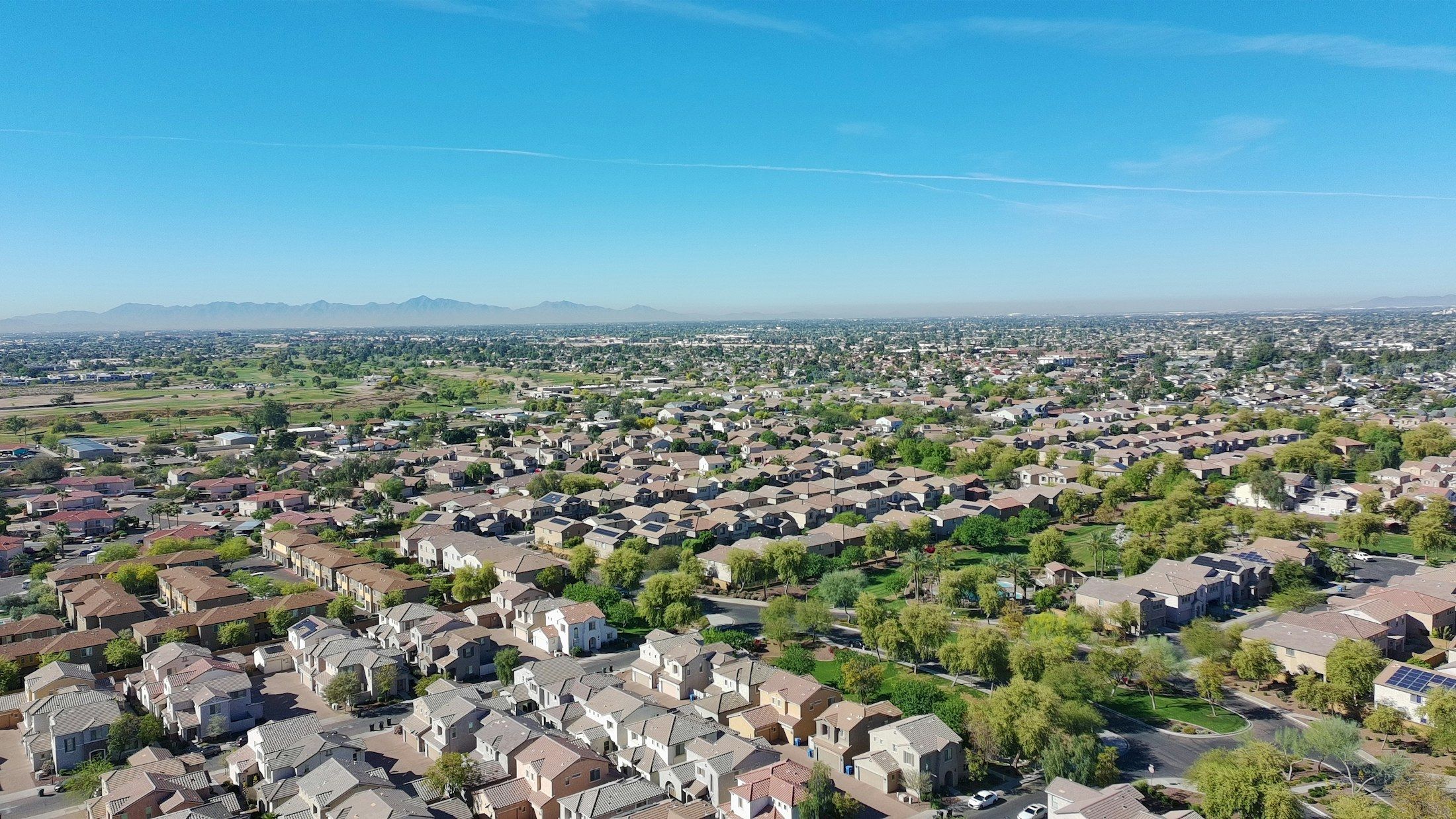
Arizona’s newest town
Voters approved incorporation on August 5, 2025, with about 66% voting yes. On September 17, 2025, the Pinal County Board of Supervisors formally approved it, and San Tan Valley became a town. The county kept providing services through June 30, 2026, and since July 1 the town has handled building permits and zoning.
Two things can be confusing:
- The name covers more than the town. The town covers about 34.6 square miles, and its boundary doesn’t take in every neighborhood people call San Tan Valley. Outside town limits, Pinal County is still the local government.
- Census numbers describe the older area. The Census Bureau still lists a San Tan Valley “census-designated place,” an area it draws for statistics. It covers 75.8 square miles of land, and most of the survey period came before incorporation. The housing figures below describe that larger area.
Homes from the 2000s boom
U.S. Census Bureau survey data (American Community Survey, 2020–2024) puts the median home in the San Tan Valley area at 2007. About 61% were built from 2000 to 2009, and about 92% in 2000 or later.
ENERGY STAR puts the life of a tank water heater at about 13 years, so a home still on its original tank is past that mark. Supply lines and washing machine hoses from the same era are worth checking too. See burst pipe water damage.
Very hard groundwater
EPCOR’s San Tan system serves most of the area, and its 2025 water quality report says “Groundwater is the sole source of water.” The report puts hardness at 15 to 18 grains per gallon. EPCOR classifies anything above 10.5 as “Very Hard,” doesn’t treat the water for hardness, and reminds customers to maintain softeners and reverse osmosis units.
Hard water leaves scale in pipes, fixtures and water heaters. ENERGY STAR warns that waiting too long to replace a failing tank risks “tank rupture and water damage to the floor and carpets.” See water heater and appliance leaks.
Pinal County, not Maricopa
Much of the Valley’s flood guidance comes from the Flood Control District of Maricopa County. San Tan Valley is in Pinal County, so flood questions go elsewhere. A draft town ordinance would have the Pinal County Flood Control District act as the town’s floodplain manager. Pinal County also runs the sandbag program: it supplies sand and bags, you bring a shovel, and the limit is 25 bags per household.
Pinal County’s flood insurance page is direct: “Homeowners’ insurance does not cover flood damage.” The county takes part in the National Flood Insurance Program, so anyone in the county can buy a flood policy, and most policies have a 30-day waiting period. The county adds that “Most flood damage occurs in non-flood zone ‘A’ areas.”
What the 2026 drainage study found
A three-year Pinal County drainage study, reported by the Pinal Post in March 2026, looked at a 68-square-mile watershed around San Tan Valley:
- 222 homes and businesses could see up to six inches of water ponding directly against them in a 100-year storm, about 2.65 inches of rain in 24 hours.
- Smaller storms count too. The study found 43 structures flooded in a 10-year, 6-hour storm and 66 in a 10-year, 24-hour storm.
- Most hazards aren’t on FEMA maps. “The only federally mapped floodplain in San Tan Valley is the Queen Creek Wash.”
Problem areas named in the study include Skyline Drive and Ware Farms, where culverts were filled with sediment, plus Morning Sun Farms, Bella Vista, Copper Basin and Quail Run. After storms in October 2025, the mayor toured Skyline Drive and said “businesses flooded, and the damage was significant.” More than 2 inches of rain fell across San Tan Valley on September 16 and 17, 2026. See monsoon and storm water damage.
Sewage backups
Sewage overflows are part of the area’s documented history. In 2019, public radio station KJZZ reported that customers near San Tan Valley had complained of sewage overflows under the area’s former private utility, and the Arizona Department of Environmental Quality said overflows in that service area had triggered inspections and enforcement actions. EPCOR took over operations in 2018 and completed its purchase of the system in 2021. If your home is on septic instead, Pinal County permits and inspects on-site systems.
Sewage in the house is Category 3 water under the IICRC restoration standard, meaning it’s grossly contaminated. The EPA says not to use fans until you know the water is clean. See sewage backup cleanup.
Where to start
Stop the water, stay clear of wet outlets and cords, and photograph the damage before cleanup starts. Then call to reach an independent restoration provider that serves San Tan Valley. The first-hour guide covers each step, and the insurance guide covers flood versus leak claims.